Author: Verse

  • Giant Steps : Jazz Everywhere

    — Ofelia T. Sta. Maria

    Outside a small, nondescript bar in Thamel, a tourist district in Kathmandu, Nepal, is a handwritten window sign saying ‘live jazz.’ Not exactly a conventional sight in a place dotted with souvenir shops, trek agencies, and guest houses’”a stretch of street where life seems fleeting, hundreds of voices speak in different languages, and a cavalcade of travelers will eventually leave at one point.

    I entered Full Moon bar, and knowing Thamel to be a place for tourists and backpackers, assumed that it would be filled with foreigners like me. I was right, but the sight of a local audience was a welcome reprieve and presented a positive omen. The atmosphere offered a stark contrast to the transient bustle of outside ‘”hued cushions and pillows to sit on, incense sticks burning in corners, cigarette smoke rising from ash trays, opened windows inviting the cool wind of spring, beer bottles, glasses of alcohol. While outside Thamel was all about passing and moving, inside Full Moon, it said SIT.

    The place was very interesting, not only because I was there as a tourist, but because I hadn’t really gone to similar events in the Philippines. I did not know what to expect.

    Jazz in Nepal

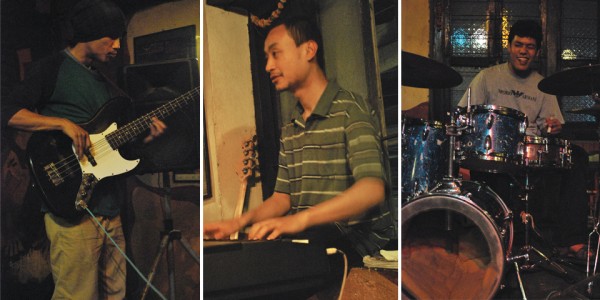
    Coexisting with Nepal’s already rich culture is an underrated music scene that deserves attention and appreciation from listeners all over the world. On my visit to Full Moon, I met Abhisek Bhadra, keyboardist of jazz group JCS Trio (with Jigmee Dorgee Sherpa on bass and Kiran Shahi on drums), the band playing that night. I’m not an expert on jazz, but the moment I went inside, I knew that these guys were good.

    Abhisek said that the jazz scene in Nepal is slowly gaining ground. It only started to develop about five years ago, when there were only about two bands playing jazz music, ‘and not many people who attended those gigs,’ he said.

    ‘It’s hard enough making a living out of music in Kathmandu and it’s definitely harder making a living by playing jazz. There aren’t many bands who’ve made jazz records here,’ he admitted. There is, however, a lot of improvement’”which shows that the scene could only get better.

    He told me about the Kathmandu Jazz Conservatory, a major initiative that helped jazz bloom in the country: ‘It was founded by Mariano Abbelo, a Spanish music educator. He was able to bring teachers from abroad to teach students here, and he’s still doing the same.’ This school benefits artists like Abhisek, because he gets to teach kids how to play’”while currently training at the conservatory, he teaches guitars, keyboards, and music technology at the British School in Kathmandu.

    Today, there are weekly jazz gigs in different venues in Kathmandu, and occasional jazz festivals, which I unfortunately missed. He mentions ‘Jazzmandu,’ an annual jazz festival that gathers musicians from all over the world. ‘The festival started about six years ago. It wasn’t very big back then but now [the number of] people attending this festival has grown,’ he says.

    Learning about all of these things, I reckoned that the jazz scenes in the Philippines and in Nepal are very much similar.


    Jazz in the Philippines

    The influx of new music in the Philippines could make it a bit trickier for jazz, partly because it’s become clear that it is one of those genres that is not easily and immediately appreciated by everyone’”an acquired taste as some would call it’”and partly because the dominant music we have for the youth in Manila commonly leans more towards rock and pop.

    ‘No matter which decade we’re talking about, jazz has always been considered an elite music,’ said Collis Davis, one of the producers of the documentary ‘Pinoy Jazz: The Story of Jazz in the Philippines.’

    He also believes that we are currently living in a time where jazz is not as well-received in the country as it should be. ‘Listening to what I would like call real jazz is more demanding of the listener’s intellect, especially when it comes to following the spontaneous, often brilliant logic of improvisation composed on fly on a theme or on a song’s harmonic structure,’ he explains.

    He also suggests that guidance is an essential component in finding out what jazz is all about, and that it could be difficult for new listeners to look for a good introduction’”it is possible that they get the ones that are ‘either too abstract or, if it’s conventional jazz, poorly executed.’ Educating oneself with sound is clearly one of the things that jazz listening requires. ‘Where it needs to be taught is at the high school level while young minds are still receptive to new ideas and the performing arts in general,’ he added.

    ‘Usually, the way one learns to listen and enjoy jazz is to associate with folks who are already into the music. They can serve to introduce the novice into how to listen to jazz, and share recordings by the jazz masters to enable the novice to engage with the best examples in the history jazz. This is key’”introducing novice listeners to excellence in improvised music, either American or Filipino in origin guarantees their life-long dedication to the music.’

    Filipino Jazz music made for and by younger generations has been doing pretty well for years. Artists such as The Radioactive Sago Project, Mishka Adams, SinoSikat?, Nyko Maca, and Mike’s Apartment each have their own distinctive jazz sounds, providing listeners with new approaches and fresh technique on the old tradition. The recently-concluded Philippine International Jazz Festival has also shown that the scene is more powerful than ever.

    ‘As the PI Jazz and Arts Festival grows each year, I would surmise that the music is gaining more attention among youth audiences due to the many free concerts that are staged around town,’ said Davis.

    Aaron Gonzales of contemporary jazz pop band Hidden Nikki said that there are no problems with regard to album sales and gigs. He said that the records do sell, but they are still outnumbered: ‘Jazz in the Philippines is like jazz in any other country. It is appreciated by people but is still part of a minority. There are fans and followers but of course, not as strong as alternative or rock,’ he explains.

    ‘Jazz survives because it is one of those genres that never die. Despite constantly not being the current fad, it’s always there unlike Rap Metal, and ‘acoustic’ that pretty much went down the popularity scale years ago. It is a timeless genre.’

    Firm, giant steps

    Heading out of Full Moon after the JCS set, I was beaming with excitement and new material for an artile that was originally supposed to feature the jazz scene in my country. I was lucky to catch a glimpse of a burgeoning jazz community in a country that already boasts so many wonderful things.

    Jazz, in places such as the Philippines and Nepal, is like the dark alley of guest houses and closed shops. Tucked away in corners is a scene that may not be as loud as the rest of the place, but is powerful enough to make you sit, stay, and listen.

    First published in the Philippine Online Chronicles (https://www.thepoc.net). Licensed under Creative Commons BY-NC-SA-3.0 Philippines (Attribution-Noncommercial-Share Alike).


  • Insfrastructure in Nepal

    We all wonder about the future of our countries, if they will prosper or fail, succeed or not, especially now, when we hear reports of political upheaval, natural disasters, and crumbling economies. I am pretty new to Nepal. I have only lived here for a total of about eight months, but I too wonder about its future, how it will be successful and sustainable, maintain peace and economic prosperity. One of the things that many Nepalis worry about, especially in the wake of October’s earthquake, is infrastructure. In rural areas, in particular, much of the infrastructure present in Kathmandu, like good schools and effective hospitals, just does not exist. However, Kathmandu also struggles to maintain its infrastructure and faces certain challenges unique to urban areas. As a foreigner, I came to Nepal with little knowledge of the infrastructure here. However, while living in Kathmandu and travelling around the country I have learned a lot more about the matter partly through dealing with the consequences of lagging infrastructure first hand.

    Over the Nepali festival of Tihar, I went on a trip to Butwal, Palpa, and Lumbini with my family. All of these places are pretty highly populated, easy to reach by car, and Lumbini, in particular, is often frequented by tourists. However, even there, much of the infrastructure apparent and present in Kathmandu is missing. Butwal was a bustling city, a crossroads for business, and only about six hours from Kathmandu. That is why when we had to make a trip to the emergency room, I was shocked by its crumbing walls and crowded rooms.

    While my husband and I were traveling to Butwal, we stopped for lunch at a road-side restaurant. The food was tasty, and we had eaten there before with no problems. However, on our second day in Butwal, my husband fell sick with a stomach bug, most likely from our meal on the road. We tried to treat his symptoms with Digene to calm his stomach and Cetamol for the pain, but he just was not feeling any better. On Tuesday night at about 10pm, my father-in-law decided we needed to go to the emergency room. I was expecting something like the major hospitals in Kathmandu, with clean enough rooms, ample hospital beds, or at least a place to sit down, but I was in for a shock. Even though Butwal is a busy, highly populated city, their emergency room was very minimal. When we walked in, I immediately noticed the crumbling, dirty walls whose corners were filled with cobwebs. Patients were lying on the floors in the crowded waiting room. Inside the main treatment room, even though hospital beds lined the walls, there was no room for my husband. After standing around for a bit, the nurse suggested he double up with another patient in one of the thin beds. Family members of the sick also had little room to wait. One family of four had gathered on their relative’s hospital bed to eat dinner. Although the doctors and nurses were obviously overwhelmed with the load of patients, we were lucky to be seen quickly. After describing his symptoms, my husband was immediately diagnosed with food poisoning, given a shot of pain killer, and sent home. I have often dreamt about living outside of Kathmandu’s hustle and bustle, crowded streets, and pollution. However, poor infrastructure keeps us from moving into a cleaner city. The health care in Kathmandu is simply the best in Nepal, and that is one of the primary reasons we choose to stay here.

    online casino best
    Besides hospitals, schools are another piece of infrastructure that are lacking in many areas outside of Kathmandu. When I lived in Nepal as a study abroad student, I went on a trip with my program to Bandipur, a beautiful hill town on the way to Pokhara. It is known for its private school, Japanese Notre Dame School, founded and run by Japanese nuns. This school is one of the few outside of Kathmandu that sends its students to colleges and universities abroad. Although I knew that schools like this one are few and far between, I did not realize just how poorly funded and inaccessible schools in more remote and rural areas can be. A few months after traveling to Bandipur, my program went to a much more rural village called Simigaau in the Dolakha District of Nepal. It takes about two days to reach Simigaau, one day by bus and one by foot. The village there has a very minimal school up to grade 5. Although the students living in Simigaau can only attend elementary school, they are lucky to have a school so close. Some of the students who live outside of the village walk up to two hours to class in the morning because their own villages do not have schools. If students in Simigaau and the surrounding areas want to continue on into middle and high school, they have to trek for several hours on Sundays to reach the closest one. During the week, they live and cook on their own at the school location and travel back home on Saturdays. Simigaau is not nearly as remote as some other areas of Nepal. They receive some aid from non-governmental organizations and they get a number of trekkers traveling to the lake Cho Rolpa and study abroad students like me. All of these sources bring in some form of money or assistance to the area. People living in more remote villages that receive less assistance must face worse infrastructure and weaker schools.

    Schools in Kathmandu are ubiquitous, easier to get to, and many consider them to be better. While in Butwal last week, I talked with one of the 16-year-old grand daughters of our hosts. She was home for Tihar but usually lives in Kathmandu. Although she studied up to middle school in Butwal, she now attends a high school in Kathmandu because her parents felt the one in Butwal was not good enough. Sending children to boarding school in search of a better education is common among Nepali families who can afford it. A number of the students studying in Kathmandu come from outside of the valley because the schools in their home towns are not as good. One of the best schools in Kathmandu, Budhanilkantha, is a boarding school that reserves half of its spots for students from outside of the valley.

    Although Kathmandu has many more facilities than other areas of Nepal, it too struggles with infrastructure. Anyone who has visited knows the roads have a plethora of potholes that are never fixed. Those who have visited or lived here in the winter know that 16 hours of load-shedding is not uncommon. Because the city has become so crowded, and because the government cannot provide the time and money to replace some of the lagging infrastructure, things in Kathmandu are sometimes worse than in other places, and the consequences of lagging infrastructure are higher. Last month, we had one of the biggest earthquakes in Kathmandu in decades. I was born and raised in the Northeastern United States, an area that just recently saw its first earthquake in my lifetime. Although my husband, a Kathmandu native, grew up with them, this earthquake in October was quite a shock for me. After the quake, everyone started talking about the bad infrastructure in the valley. The houses are close together and made of bricks and cement, heavy materials that could kill many if a more serious earthquake hits. Earthquakes can have terribly damaging effects on rural areas, but in highly populated, densely packed places like Kathmandu, an equivalent earthquake produces much greater damage.

    Infrastructure allows a city to run smoothly. Reliable sources of electricity and usable roads make it possible for businesses to open and operate and for people to commute to work. Certain infrastructure like schools and hospitals ensure the long-term sustainability of a community. Having good schools produces students who can go on to join the workforce, and having good hospitals keeps a city’s citizens healthy and able to go about their daily lives. Not only does reliable infrastructure make it possible for things to run smoothly, it also attracts those with money. This brings in more resources that can further be funneled into schools and hospitals and into improving the roads, electricity sources, and other infrastructure. However, it is important to note that more infrastructure is not always necessary. In villages where subsistence farming is the common profession, people do not necessarily need roads for their communities to run smoothly and sustainably. There are some aspects of infrastructure that can benefit everyone, like water pumps with clean water or hospitals, but not every community needs the infrastructure that cities require to be successful.

    Kathmandu struggles with certain aspects of lacking infrastructure, like poor roads, and load-shedding partly because of its high population. The increased use brought on by so many people wears on the resources. Other areas, because they do not struggle with high population, do not face the same challenges that Kathmandu does. Some communities are also actively working to improve their infrastructure, sometimes with the help of outsiders. The Japanese Notre Dame school in Bandipur is a prime example. Although the nuns started it, it could not run without the help and support of the Bandipur community. Another example comes from Simigaau. People there have also striven to bring better infrastructure to their community. They have their own hydro-electric generator, and many families there have running water, a luxury that some households in Kathmandu do not have. They use the slope of the hills they are living on to bring running water to their houses. As infrastructure outside of the valley gets better, there will be fewer people coming to Kathmandu in search of better resources. This will reduce the strain on infrastructure here. Maybe one of the best ways to improve infrastructure in Kathmandu is to start by improving it elsewhere.

    It is unquestionable that those living in areas outside of Kathmandu, especially rural areas, have less access to some very important infrastructure, including good hospitals and schools. However, Kathmandu lacks in certain areas of infrastructure as well, including safe roads and reliable sources of electricity. What is the future of infrastructure in Nepal? There are plenty of NGO and INGO’s fighting to building better water resources, electricity sources, schools, hospitals. Some of the change is fueled by foreigner inpiduals like Maggie Doyne who founded the Kopila Valley Children’s Home and School. Other change has come about through larger organizations like USAID and Habitat for Humanity. However, infrastructure does not always improve through inpiduals and organizations with a social service bent. Many Nepalis have improved their own access to electricity through the installation of solar panels in their homes, and some Nepali businesses are building hydo-electric generators to produce electricity that they will sell to the government. Lack of infrastructure often affects the poorest people, who cannot afford to send their children to better schools, travel to Kathmandu for health care, or put solar panels on their houses, but I feel that change is coming. Nepalis and foreigners have both started to enact change that will lead to better infrastructure.

  • It was Day 1 of Jazzmandu: Jazz for the Next Generation. 3 local groups participated for a chance to play in Jazzmandu 2011. This was the first time that I was introduced to Neighbourhood, a six piece band from Stockholm formed by trombonist Kristian Persson in 2009. The auditorium could not have been more crammed. And I couldn’t have been more anxious to hear them perform. From the beginning, the energy in their music was clearly unmistakable. Their sound was strong, complete and well backed. It was astoundingly memorable to all those who saw them perform.

    [quote_right]Jens Filipsson ‘Saxophones amp; Flute
    Jonne Bentlöv ‘Trumpet
    Edvin Nahlin ‘Keyboards
    Aleks Brdarski ‘Bass
    Sebastian Ågren – Drums
    [/quote_right]

    Having been inspired by a range of sources, their music itself is unique and cannot be bound to a specific genre. Elements of jazz, funk, soul, Ramp;B shine in their original instrumentals primarily composed by Kristian. The horn section distinctly sets Neighbourhood apart from other jazz outfits; the arrangements of their tunes, especially the ballads reflect genuine harmony. Kristian (on trombone), Jonne (on trumpet) and Jens (on sax) complement each other perfectly. And if the horns weren’t enough of a treat for the ears, Aleks’ solid grooves locked in with Sebastian’s exceptional drumming takes you far. Sebastian makes it look easy and his solos always have clear motifs. Edvin’s comps are superb and his selection of adding colour made their sound novel each time around.

    They showed great technique and musicality and their solos were well thought out and well executed. Kristian’s accuracy was more than impressive; his phrasing mind boggling and the control with which he played was phenomenal. Jonne stood out with his be-bop influenced sound as he shared in the Masterclass. Jens always stole the show with the occasional high accents and Edvin quietly smiled away while making his solos the icing above the cake. Aleks held everyone’s breath with his long and emotive phrasing; after every phrase you could go ‘wow!’ and hold your breath for another long pharse. Sebastian commanded his solos with mature dynamic precision and while he made it look easy, I’m sure it wasn’t.  Their distinctive on-stage communication and support is thoroughly entertaining especially when any single instrument is soloing.

    Neighbourhood is truly an inspiring act.  Though forming only a couple of years back, they released their debut ‘Maybe Tomorrow‘ in 2010 and have received sparkling reviews not receding 4 stars. With such fantastic originals with such arrangements, you have to give them credit for being as innovative as they are. I personally would like to thank Kristian for making this possible; coming to Kathmandu and inspiring all of us who got a chance to watching Neighbourhood. Their album is available on Itunes and they also have a few videos on Youtube for you to check out! Or check out: myspace.com/jointheneighbourhood , where you can find their songs, pictures and tour dates.

    Q. How did you hear about Jazzmandu? What made decide that you wanted to come to Nepal?

    ‘I just happened to find it on the internet. I liked the concept of music for peace and compassion and the idea of going to Nepal was really tempting as well.’ – Kristian Persson

    Q. How was your experience in Nepal? Could you highlight some of the high points of this visit, hopefully individually?

    ‘Nepal seems to be a great country which is rich in nature and life. Kathmandu for me was really humbling. All the people we’ve met have been really friendly and easygoing. Our stay and gig up in Gorkana was really amazing. That together with the show in Pathan were we played with classical musicians was a true inspiration. The whole week was a highlight but if I had to single out a few it would be those two events.’ – Aleks Brdarski

    ‘Nepal was the trip and tour of my life, no doubt! From the moment we arrived at the Kathmandu Airport you immediately felt there was a very special and relaxed vibe in the air, something that I think affected all of us in a positive way. Everyone of us felt very welcome everywhere we went, the Nepali people are truly very friendly and welcoming. Every day was a highlight for me. I experienced so many wonderful and different things compared to my ordinary life in Sweden and I am grateful for every minute I got to spend in this amazing country!’ -Jens Filipsson

    online casino games
    Q. Kristian, I believe you are just 23. Considering your age, as a composer what advice would you give to young aspiring composers who want to perform their own compositions, but believe age is a ‘limiting’ factor?

    ‘One of the nice things about music is that its not limited to age. You can communicate with anyone regardless of age as long as you yourself have an open mind. And for me that´s one of the most important things when your´re working with music. When I was around 12 years old I was playing in a local big band, with guys that where in their sixties and even older than that! So for me age is just a number.’ – Kristian Persson

    Q. How would you describe the scene (jazz, soul and funk) in Sweden?

    ‘It’s really flourishing right now with lots of young bands coming up with new fresh ideas and concepts.  The new generation of jazz-musicians also seem not afraid to be influenced by genres like pop and electronica to name a few and collaborations with electronic artists is getting more common, which we like!’ – Jonne Bentlöv

    Q. How important do you think is proper formal and/or informal training when it comes to performance?

    ‘It´s depending on what music you are performing. Some music need it more then others but in our case I think its a mix of both. Its also depending on who you are and what suits you.’ – Kristian Persson

    Q. Could you comment on some of the problems you’ve encountered in the past couple of years since the formation of this outfit?

    ‘Luckily, we all are very good friends in this band, which makes it pretty easy to tour and work together. Of course there has been times of arguments and different opinions regarding the music or other things concerning the band, but we have always been able to communicate and listen to each other, making it possible to find solutions that everyone feel comfortable with. Regarding the music scene today, and the jazz scene in particular, money is always an issue. You really have to work hard to be able to get out on tour and play your music. For us though, this just makes us wanna work even harder We believe in what we do and will always work hard for the opportunity to reach out to new listeners and spread our music around the world.’ – Jens Filipsson

    Q. Your debut album has been compared to likes of E.S.T back home, with respect to their appeal to various audiences of varied genres. Could you comment on this a bit?

    ‘We feel very honored to be compared with such an amazing group who has really put Sweden on the global musical map. They have pushed the limits of what you thought a jazz-trio was suppose to sound like and never got stuck in any pre-determined genre. We hope that we share some of that same spirit in our music!’ – Jonne Bentlöv


    Q. What is the secret of your band’s synergy and effective communication? Is it all practice or something else?

    ‘I think it’s a combination of everything. I think that it’s first and foremost about communication. We always try to communicate when we play together. If we don’t communicate, we don’t play together. However, we have all practiced individually on communication and playing together and locking in with other musicians. With that said I really bealive that we have something unique in our group. I mean we’re all good friends, but when we play together we just reach a new level. It’s really inspiring and that makes us all want to strive for something new everytime we play.’ – Aleks Brdarski

    Q. What kind of emotion(s) does your music hope to express?

    ‘The emotions of daily life and it´s up and downs. Some of the songs express love and hapiness, some others express sorrow and sadness, some of them express anger and frustration. But whats common for all of them is the collective energy you can achieve if you work together. Working this way we always end up having a real good time together and that´s what we want to share with the audience.’ – Kristian Persson

    Q. Any future plans and comments on Neighborhood and the music that you seek to explore and have already explored?

    ‘Our plan is to continue to do the things we do and to grow and improve as musicians and a band. We´re developing all the time and we´re finding new things to discover and explore more and deeper. Besides playing live we´re also working a lot in the studio, so we have new music coming up soon. We´re really excited about the new material so be on the lookout for our upcoming album!’ – Kristian Persson

    Thank you and namaste for sharing with us with such wonderful music and giving us such memorable experiences. We hope ‘Maybe Tomorrow’ will be a great success. And we hope to see you again in the future and will be looking forward to it.

  • Metallica. The band that first got me into listening heavy music. One of the bands that any ‘genre-specific’ person has heard, at least once. I first started listening with their hits, but slowly they got me very attached into their music. It all grew on to me, album by album. And being a citizen of Nepal, getting to watch them live was one of the last things I could have expected. But one summer evening when I log into facebook, there’s an invitation to like a page ‘Metallica Comes to India’!

    At first I took it to be only a hoax. Dreams for the simple minded. But eventually, I checked their official website. They had indeed mentioned about touring India. Two concerts were scheduled- one in Delhi and one in Bangalore. In the beginning, I could get only slightly excited because I just couldn’t picture myself actually watching Hetfield playing live in front of me! It was too real to believe. But calming my emotions, I began finding out more about the concert and soon spoke to one of my friends on actually attending the concert. In a few days, we made our mind. We decided to go to Delhi. A guitar pedal was sold (Metallica being the band paid most tribute by it!). Tickets were booked. Heart was set. After some days, he said that our tickets were actually confirmed- Yes, I was actually about to see Metallica Live! I had my travel plans; I had the gig tickets, now all I needed to do was be there!!

    The gig was scheduled to be on October 28 and we reached Delhi on October 27. The time passed by slowly, waiting, waiting for the clock to tick-tick-tick away faster and faster’¦.Finally, October 28, we reached the gate at 1:30 and already there were hundreds of people, just like me, waiting under the heated sun. To see them, Metallica, LIVE!! We entered the venue, scrambling against each other- hardly worrying to see who it was you were with or against. It was all push and go. A mad need. We entered the venue and there, in front us, was the stage, that big stage, where Metallica were actually about to perform!

    We were not sure who the opening band was, nor how it was about to go, but none of that mattered now that we were going to see Metallica for sure. The gig was scheduled to start at 4:00, but half an hour past the schedule and still there were no signs of any bands opening. The audience was getting impatient. A feeling was growing amongst us. Due to the pressure from the crowd, the barrier on the left front broke. There was confusion. An announcement was made by the officials to the crowd to take a few steps back so that they could fix the barricade. ‘Take a step back if the program has to start’. The crowd did not oblige. People at every corner were getting restless. There was no sign of any music, even after an hour or two had passed after the scheduled time. Anxiety was growing. And then, things got worse.

    A man went up to the stage and announced that ‘the gig that day had been postponed to the next day, Oct 29, at 4:00 pm in the same venue’. All around me, the news hit the crowd with a shock. I was at total disbelief. I could hardly know what was going on anymore. The visions came crashing to the ground. People climbed on to the stage, began hitting the speakers, damaging the monitors and other equipments. I kept staring, not knowing what to do. The expectation; it all came crashing down.

    In the night, we slowly walked away from the venue; from the joys of hours past. There was little to be said. Later that night we came to know through the news channel that the gig has actually been cancelled. An official statement. Over time, I heard many things from people. Many say, and I partly agree, that it was poor management that caused this. Some say it was to be expected. For myself, I know I was not expecting this. Many things can be said, but I don’t think it is easy to write out those feelings. It isn’t easy to say how I still feel, to have to return without watching them, when at one point in time, I was only ten steps away from the stage. Ten steps away from where Hetfield would have made love to his guitar. Ten steps away from where they would be playing what I first regarded as good heavy music. The failure of the gig is also a national level embarrassment. That is what will happen if managers underestimate the crowd capacity for a band like Metallica.
    From that guy who would have sang the songs word to word and remembered the day for his lifetime, I say, hats off to the Indian organizers, who were able to fool 30,000 people at a single time on a single day- which led October 28 to be the best day I never had.

    This is what my friends and seniors had to say when they were disappointed like I was;
    Puru Lama (Bassist who is not currently active)  ‘So pissed off with those faggots who broke the security barricade. Those indian butt-heads really showed an Indian Attitude- arrogant, proudy and savage.
    bottom line-dream shattered, sad, unhappy’

    Monica Thapa (Runs a Montessori school in Pokhara)‘Bekar ma paisa kharcha. Cunning Indians have good ideas to make easy money’
    Raul Regmi (Plays for a local Nepali underground band ‘Consequence’)  ‘Never trust Indians! They can fool you anytime, anywhere!’

    Nikita Tripathi (Student and a local gig-seeker) ‘It didn’t feel very good returning back after waiting two hours in the sun before they let us in, tugging into God-knows-whose t-shirts, getting in and out of the crowd with much effort, spending almost three hours inside the venue’
    online casino slot

    Renasha Ghimire (Nepali student at a Punjab University) ‘ With all hopes shattered it’s ironic that I don’t want to remember what happened that day’.

    Avishek K.C (Vocalist for Underside/E.quals/Lost Oblivion). ‘I couldn’t listen to my favourite band ever. What was going to be my happiest day ever turned out to be the saddest day ever’

    And this is what Sujan Shrestha and Saleem Akthar, who were one of the organizers of the recent SUCCESSFULLY held ‘Silence Festival’ headlined by VADER, had to say when they returned with sad faces too.
    ‘It’s a shame for a team like DNA to have failed to manage such an event. 30,000 sad faces on a single day for a single cause-well, if that doesn’t make DNA one of the worst event organizing teams ever-what does?’