Author: Verse

  • Life In Black and White

    People at Keshav Narayan Chowk, Patan Muesem where thoroughly enjoying the fourty five photographs from 19 years old Shisir Maharjan.
    ‘Life in Black and White’ was the first exhibition of Shisir, who express black and white photography as a powerful medium to bringing life in a frame. The 45 photographs include portraits, lifestyle, candid pictures, cultural and natural images of Nepal. The photographs showed true emotions undisturbed by colors. Each photograph in the events was priced at Rs. 6000.

    https://www.flickr.com/photos/41686346@N06/

  • Activism via Social Networking

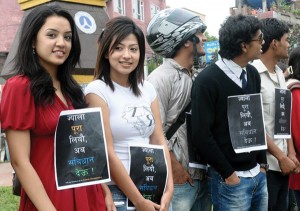
    Nepalese from all walk of life, students professionals as well as a broad alinces of citizens are now following the slogan ‘Jyala pura liyau, aba sambidhan deu’.

    ‘Jyala pura liyau, aba sambidhan deu’ is organized by Nepal Unites. Nepal unites is an informal group of concerned Nepali citizens demanding the timely draft of the Constitution and the conclusion of peace process. These people share the common ground for activism , digital media.

    This growing mass of Nepal unites (coined as twitteratis; very, very angry youths, white color urbanites from our respected critics) is organizing rallies, events, concerts and interned base campaign to make the law maker understand those ninety five minutes they provided to writing constitution on Nepal in last three years was their incompetence and dishonesty to Nepalese citizen.

    https://facebook.com/nepalunites
    https://www.nepalunites.com/


  • Bollywood is a time machine (no kiddin’)


    — Ashesh Maharjan
    https://amaharjan.wordpress.com/ 

    Hindi movies are crap. And I know it isn’t the first time you are hearing this, they really are, except for few (very few). But here I am taking this challenge to write against this cliché. No kiddin’.

    Hindi movies have a special place in our (Nepalese) hearts. Cheesy as it may sound, but it’s true. Whether you like it or not, whether you admit it or not, it has become a way of life for almost all of us. I don’t mean bollywood movies when I say ‘it’, I mean our secret admiration for the cheap, corny bollywood movies. Now, don’t tell me you don’t, once in a while, feel like doing nothing but sit back relax and watch a hindi movie channel. The fact that those channels stretch an hour long movie into what seems to be for ever with their advertisements matters less. You just want to get hold of the remote and turn off your mind and watch. The ‘mind turning off’ part wasn’t figurative, you can literally turn it off since you already know (not guess) what’s next in the movie.

    I’m a huge fan of, say, Ron Howard or Steven Spielbergh. And I’m not kiddin’ when I say I watched this movie, as recently as a few months ago, in which the so called ‘hero’ is a dancer, singer, super-man, every good thing you could possibly imagine, and of course romantic at the same time. My point? Is that I don’t ‘not watch’ them. Reason? I feel damn good. Not good as in ‘wow!!! WTF’ good, but ‘good day, sunshine’ good. Now, don’t get me wrong, no, the director of photography of these movies aren’t at all masters, most of them are crap. Well, I know you are dying to know (LOL) where my talk is heading. Ok, here is what I mean.

    Imagine yourself as me. No don’t do that. Imagine you as yourself but you are a 10 year old and you feel swell as hell because you just learned how to ride a bicycle by yourself though you sit on top tube instead of the seat coz you aren’t tall enough. You rush to tell your sister that you didn’t even notice you were riding by yourself and that you are ‘awesome!’ Your sis gives a damn coz she is a Sharukh Khan fan and Zee TV’s showing ‘Kuch Kuch Hota Hai’. And you go and lay flat on the couch and start watching, though the sound of people cycling and playing cricket just outside your room in the courtyard makes it impossible for you to fully hear the movie. These are the days when movies start making sense for the first time in your mind. These are the days when you have your first of crushes on a girl in your school. Not because she is a John Petrucci or a Blink-182 fan, but because she doesn’t cry on the way to school or she has neatly cut fingernails.

    The movie ends’¦ You stretch yourself up (coz hindi movies are at least 2 hrs long and with the advertisements they are 3 to 4 hrs at the very least) and you dab your tired eyes and you open them to find yourself in the present.

    Enough of time traveling. Basically, what I mean is that it’s obvious that hindi movies are the first movies that we relate to. We weren’t born movie critics. We can’t watch the first movie of our lives and tell that the plot of the movie was shitty and all. So, we have no choice but to feel fine watching these movies of our times missing our sisters and our brothers (he was the one backing up my bicycle LOL).

  • The Big Bookshelf

    — Ajit Baral

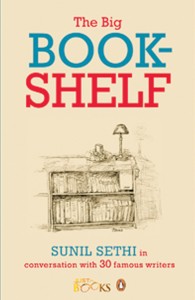
    In February 2005 Sunil Sethi, a journalist, columnist and television presenter, started a weekly program on NDTV called ‘Just Books’, in which he interviews famous writers. He has interviewed over three hundred writers so far. Some of these interviews’”thirty, to be precise’”have been collected in this beautifully produced book, ‘The Big Bookshelf.’

    Many of these writers are literary heavy weights including Gunter Grass, Nadine Gordimer and Salman Rushide; others are the finest exponents of crime fiction such as Ken Follet, Jeffry Archer and Alexandar McCall Smith; others still are the immensely popular writers of the cheap and not chick-lit kind including Chetan Bhagat and Shobhaa De. Engaging the authors on topics such as the craft of writing and why they set out to write, Sethi’s interviews provide a rare insight into the lives of literary greats.

    Anita Desai, a writer who twice narrowly missed receiving the Man Booker Prize, reveals during her interview, for example, that:

    ‘I was a wife and a mother and writing was not what I was supposed to be doing. I had to do it in hiding. I remember I used to scribble away when the children were at school or playing downstairs and quickly put everything away before they came back in. My children always remark that they never saw me writing. And the book would one day appear, as though it just happened, it came from somewhere else.’

    Glimpses, such as Anita’s, of the struggles and successes of writing are littered throughout the interviews that make up ‘The Big Bookshelf.’  Interesting to for book lovers and inspirational for aspiring writers who don’t know where to start; this is one title that is a great addition to any big bookshelf.

    However, some readers may feel as if they are tucking into an unripped fruit which isn’t quite there yet. That has more do with the fact the collected interviews are the transcripts of a 30-min television program. Being short, the program does not provide time enough for Sethi to tease out more answers from the writers, which would giving the interviews a more-rounded feel. Unlike the ‘Paris Review’ Sethi fails to engage fully with the writer’s oeuvre, often skirting more informed context based questions. Similarly, being a television program having a different’”and dare I say, a less bookish’” audience, the program skims over fundamental questions about the craft of writing. Inquiries about a texts plot, writing style, technique, characterization and pace are replaced instead with peripheral and controversial questions such as the break up between Salman Rushdie and his former flame, Padma Laxmi.

    These shortcomings notwithstanding, you will find the book interesting’”that is, if you are not used to reading ‘Paris Review’ and ‘Wasafiri’ interviews, which are more engaging.