Author: Verse

  • TOILET TAO : A review of toilets on the Langtang trail.


    — Nashiu Zahir

    There’s an old tale from neighbouring India that goes like this: a king summoned his advisor, Beerbal, who was immensely clever but very unorthodox, to court to ask him this question: what is the one thing that can make a man most content?

    But before Beerbal could answer, several others responded with cries of ‘money’, ‘an obedient wife’, ‘healthy offspring’ and ‘devotion to the gods’.

    ‘And what do you think, Beerbal?’ his majesty asked.

    ‘If you will forgive my honesty sire, a good bowel movement when one truly needs to go.’

    Maybe only the weak and uninitiated would ponder such trifles as the state of toilets en-route to Langtang Valley but I admit: toilets figured prominently in my mind when I hiked up those foothills the first day. Nevertheless it stands to reason, that the last thing you would want after a hard day’s walk is a crap toilet.


    [quote_right]Hygiene: 4
    Smell: 3
    Comfort: 2
    Accessibility: 5
    Toilet Tao: 3.5
    [/quote_right]

    At our first stop in Thulo Syabru, four hours from Dunche, the toilet took me by surprise; it was highly accessible ‘“  just a few steps from my room and a squatter, but spotless.  There were also several hooks for clothes (as it had a shower). The flush pail wasn’t grimy and the little jug inside was not coated with slime. And the moment I stood up I was graced with a view of a sloping, pine-studded hillside beyond in which Lirung stood, surrounded by a host of other snow-clad peaks, crimson in the early morning light. It would have been an exceptional sight anywhere, though the feeling was only intensified by my awareness of where I was.


    [quote_right]Hygiene: 4
    Smell: 5
    Comfort: 2
    Accessibility: 5
    Toilet Tao: 4
    [/quote_right]

    My initial misgivings had been dispelled somewhat, and I had certain expectations for our next stop, Lama Hotel. Lama Guest House had two out-houses which I overlooked, but the toilet upstairs was decent. It was closet sized and the toilet and bucket were both blue, which contrasted with the wood of the walls. The cracks in the wood allowed a draft and kept the place well ventilated. And the disposal bin was a hand woven basket; definitely the best of its kind as far as this trail is concerned.


    [quote_right]Hygiene: 5
    Smell: 4
    Comfort: 5
    Accessibility: 5
    Toilet Tao: 4.5
    [/quote_right]

    Perhaps the strangest thing found at high altitudes in a country as desperately poor as Nepal is a ‘western style’ toilet. And it’s even stranger when I struggle to find one thousands of feet below. But in Langtang Valley, 3475 metres up at Village View Guest House, the toilet was a wonderful, white, non-squatting affair with plenty of paper and a bin within easy reach. Sure, the flush tank took a while to fill up, but it did not have the smell that many toilets have which made waiting easier. And it was indoors so you were spared from having to brave the elements every time you needed to go.


    [quote_right]Hygiene: 2
    Smell: 1
    Comfort: 2
    Accessibility: 3
    Toilet Tao: 2.5
    [/quote_right]

    But five hours from the Valley, in beautiful Kyenjen Gompa, the toilet at Yala Peak Guest House was dark and smelled like the privates of a sadhu. And it was a squatter. But no skid marks. And no space to hang one’s pants either. It was part of the main building but in an open corridor, so a confrontation with the elements was necessary, if only for a moment. The flush pail was grubby and the disposal bin overflowed. Contact with any surface required an extra dollop of hand sanitizer, just to be safe. It was a funny coincidence, however, that the highest point on our trek was accompanied by the lowest toilet tao.

    All in all, however, Langtang toilets are well maintained thus facilitating sound bodily functions. It does not take a lot to imagine Beerbal himself enjoying his early morning dump on the Langtang trail.

     

  • The Imprints of a Soul

    (Part 1) A Labour of Love.

    I admire the hands of the craftsman,
    Nimble and quick,
    Steady and slow.
    Weaving the lives of
    Those who do not know.
    The same feet,
    Carrying the load.
    Toiling, struggling
    for this chapter
    to close.
    Sweat, for the child
    still unborn.
    The pages are torn.
    Wandering devotion
    instilled in faith.
    You have the answers.

    Why do you wait?


    (Part 2) The Trials of Time

    Symmetrical to the heart
    You have within,
    Are the grains of sand
    that make up this land.
    Watch from your seat
    as history is formed,
    Or lies,
    For all they know.
    In the future,
    They speak with their eyes closed.
    Repeating stories
    That have already
    been told.
    Awaiting,
    an end
    to a seed
    ungrown.

    You can’t find a place.
    There is no place to go.

  • Brainwashing Your Face – Exit Through the Gift Shop

    — Ofelia Sta. Maria

    A few weeks ago, an image of Osama Bin Laden’s face painted on the Christ the Redeemer statue in Rio de Janeiro, Brazil was reported to be Banksy’s latest stunt. This could immediately sound like a hoax (it was), were it reported under a different name, but it was Banksy, the one who painted nine images on the walls of the West Bank in Palestinian territories. Banksy, who succeeded in placing his own work in between classic, century-old museum art pieces; Banksy, the world’s greatest and sneakiest freak of nature.

    After thousands of canvases, successful installations, empty paint cans, and success in avoiding the cops, he had found another way to make art. It was only last year that the world saw a full-length Banksy film documentary, and we thought we’d finally catch a clearer glimpse of him, but we don’t. If anything, more questions are raised.

    Exit Through the Gift Shop can and will make people wonder how the graffiti ninja did it, but it’s possible that he’s conned his audience. Again.

    What happens in the film: Thierry Guetta, a French man selling vintage clothes for a living, is obsessed with filming everything around him. He finds out that his cousin is Space Invader, a French Street artist known for his mosaic tile works. Because of this, Thierry developed an interest for street art. He started following different street artists and eventually meets Obey (Andre the Giant has a Posse) creator Shepard Fairey. He follows Fairey and other artists wherever they go’”filming the process of printing and stenciling to the installation of the pieces on the streets.

    Eventually, Thierry hears about Banksy, who surprisingly agrees to be filmed. The French man follows Banksy everywhere and when all the footage is done and edited, Banksy decided that Thierry’s just ‘someone with mental problems who happened to have a camera,’ and what he made ‘was an hour and a half of unwatchable nightmare trailers.’ Banksy’s solution: Thierry should let go of the camera so he can do the documentary himself, and go out and make art. Thierry obeys this, starts calling himself ‘Mr. Brainwash,’ produces one of the highest selling art shows, and sells meaningless pieces adored by (rich) people and the media.

    This, again, sparks the never-ending debate on how important a piece of art is, and how it’s supposed to be appreciated. Thierry wheatpasting a huge print of his face in the streets makes for interesting debate on the philosophy of street art. If you’d interpret this as a real documentary, you’ll see how Banksy experiences absurd real-life events on overnight artists like Thierry, and how even he’”a street art god’”cannot control it. While the Frenchman spent just a few months working on a show and became more focused on its publicity rather than the pieces, everyone he filmed in the beginning showed passion; working on their craft for years (Fairey specifically mentioned that he has been doing it for more than 10 years).

    ‘Most artists take years to develop their style, Thierry seemed to miss out on all those bits,’ said Banksy.

    Let’s say everything in the movie actually happened’”some French guy with a video camera happens to be Space Invader’s cousin, was entertained by Fairey, got ahold of Banksy (who is possibly not human), and became a millionaire because of half-baked, reprinted copies of photoshopped crap dubbed ‘art””isn’t it just as interesting as the idea that none of those things really happened?

    Thierry knew nothing about street art before hanging out with the ones who live by it, but once he got the idea, he became a street artist himself. If the documentary’s a hoax, on the other hand, you will still see a commentary on how to be an artist, and what is needed to fully become one. Being able to print large papers to stick on walls does not make one an artist; that having a moniker and a Sharpie does not immediately make one a graffiti artist.

    Whether it’s fact or fiction, this film’s a ten. And it didn’t even need Beck’s cameo to prove that it’s awesome.

    The great thing about this whole thing is it doesn’t even matter anymore if the movie’s a fake or not. Either way, it is a work that illustrates something that has happened, is happening, and will happen with this counterculture and the whole art world in general.What we get from this is another form of Banksy’s genius. Once again, he did something to confuse and entertain the audience.

    This is no spoiler, but pay attention to what happens to the huge slab of concrete at the end of the film. Read what’s written on it and look at what it’s doing. Never has there been any kind of dystopian suggestion that is so hilarious, serious, and entertaining all at the same time.

    ‘That’s why I call myself Mr. Brainwash. It’s because everything that I do… somewhere… it brainwash your face!’ explained Thierry.

    Truer words have never been spoken.


  • Himalayan Style


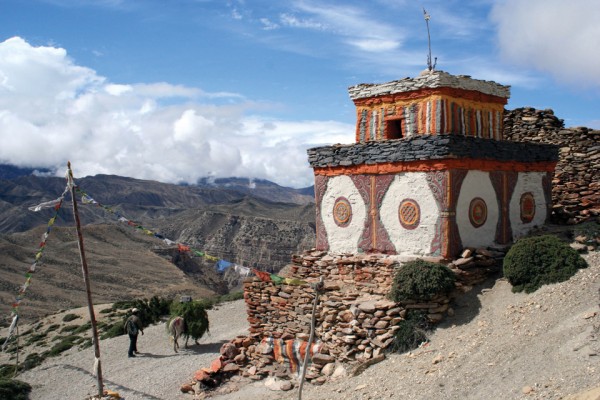
    Author Claire Burkert and Photographer Thomas Kelly are collaborating on a book that celebrates a range of Himalayan architectural styles and design. They explore sacred spaces and indigenous styles of built structures found in Tibet, India, Bhutan and Nepal. A section on contemporary style in the Himalayas includes distinctive new museums, public gardens and fine crafts. An introduction by acclaimed Buddhist scholar Robert Thurman points out the cultural and spiritual foundations of Himalayan aesthetics. The book is entitled Himalayan Style and is due to be published by Roli Books, Delhi, in 2011.

    Thomas L. Kelly first came to Nepal in 1978 as a USA Peace Corps Volunteer, and has since worked as a photo-activist, documenting the struggles of marginalized people and disappearing cultural traditions all over the world.  His editorial work has appeared in publications worldwide, including, the New York Times, Time, Newsweek, National Geographic.  He currently represents Hinduism Today and is based  in Nepal. His wife, Carroll Dunham is the Founding Director of Wild Earth Pvt. Ltd www.wildearthnepal.comNepal.com

    Thomas Kelly has researched and photographed the books: Sacred Landscape-Pilgrimage in Tibet: In Search of the Lost Kingdom of Bon, Tibet: Reflections from the Wheel of Life; The Hidden Himalayas; Kathmandu: City on the Edge of the World, Abbeville Press, N.Y., N.Y., Fallen Angels: Sex Workers of South Asia, The Tibetan Book of the Dead, Roli Books Int. New Delhi, India,) Millennium: Tribal Wisdom and the Modern World, Viking Penguin, N.Y., N.Y. and Cultural Traditions on Hinduism-Sadhus, Cuerpos Pintados, Santiago, Chile. www: THOMASLKELLYPHOTOS.COM

    Claire Burkert is an expert on crafts preservation and design. In Nepal she founded the Janakpur Women’s Development Center, which preserves and promotes the Maithili painting tradition. For many years she worked closely with ethnic minorities in Vietnam to revive traditional textile traditions and to help adapt them for new markets. With The Poverty Alleviation Fund she has assisted artisans in Tibet to develop and promote their crafts. She has written extensively about traditional art, crafts, and dress of Asia. She is based in Kathmandu with her husband Thomas Schrom, a designer and specialist in restoring Himalayan buildings.

    [minigallery link=”file” order=”DESC” columns=”2″ orderby=”title”]